
Embedding Aboriginal and Torres Strait Islander Perspectives Respectfully
- Greenwich Little Learning Hub
- Dec 10, 2025
- 4 min read
Updated: Jan 12
At Greenwich Little Learning Hub, we believe that all children growing up in Australia should learn about, and from, the world’s oldest continuing cultures. This is not about adding the occasional dot painting or boomerang to a program. It is about respectfully embedding Aboriginal and Torres Strait Islander perspectives into everyday practice, in ways that are meaningful, genuine and age-appropriate.
This article is designed for our educators and students in training – and also for families who are curious about how we approach this important responsibility.
Why It Matters

The Early Years Learning Framework (EYLF V2.0) asks us to support children to:
develop a strong sense of identity
connect with their world
respect diversity and act for fairness and sustainability
Embedding Aboriginal and Torres Strait Islander perspectives helps children:
recognise that they live on Aboriginal land
understand that Australia has many First Nations cultures, languages and stories
build respect, empathy and curiosity, rather than stereotypes or tokenism
For First Nations children and families, it also supports pride, belonging and visibility.
Principles for Meaningful, Non-Tokenistic Inclusion
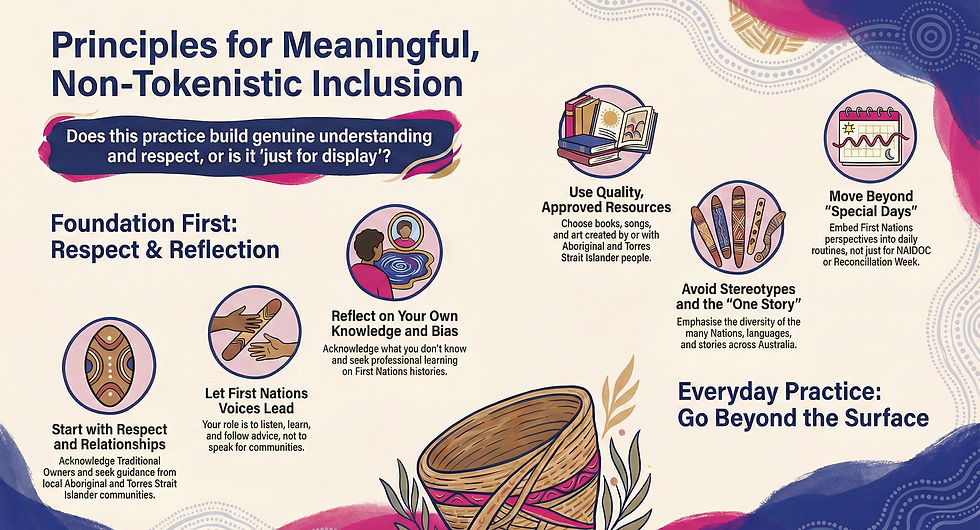
Age-Appropriate Examples for Early Childhood Settings
Below are some practical ways educators and students can embed Aboriginal and Torres Strait Islander perspectives in respectful, age-appropriate ways.
These are examples only – always prioritise local guidance and check that any stories, songs or symbols are appropriate for sharing with young children.
1. Stories and Picture Books
For children | For educators |
|
|
2. Songs, Music and Language
For children | For educators |
|
|
3. Daily Acknowledgement of Country
For children | For educators |
|
|
4. Nature Play and Caring for Country
For children | For educators |
|
|
5. Visual Environment and Documentation
For children | For educators |
|
|
Working in Partnership With Families
Families may be at different stages in their understanding of Aboriginal and Torres Strait Islander histories and perspectives.
As educators and students, we can:
Share what we are learning in simple, respectful language.
Invite families to ask questions or share their own knowledge.
Be especially mindful of how we support First Nations families to feel welcome, heard and respected.
A parent-friendly way to frame it might be:
“We want all children to grow up knowing they live on Aboriginal land, and to feel proud of the world’s oldest continuous cultures. If you ever have questions about the resources we use or how we talk about this with children, we’d love to chat.”
In Summary
Embedding Aboriginal and Torres Strait Islander perspectives is not a one-off activity; it is an ongoing, thoughtful process.
For our educators and students, this means:
Listening to First Nations voices
Reflecting on our own practice and assumptions
Planning experiences that build real understanding, not stereotypes
Honouring children’s questions, curiosity and capacity to learn about Country and culture
For families, it means knowing that when your child comes to Greenwich Little Learning Hub, they are growing up in a learning community that respects the First Peoples of this land – and invites every child to walk gently, curiously and kindly on Country.
If you’d like to know more about how we embed Aboriginal and Torres Strait Islander perspectives in your child’s room, please speak with your child’s educators or Centre Manager. We are always learning and always open to conversation.
Helpful Resources for Meaningful Practice
Reconciliation Australia - Free resources, webinars and tools for Acknowledgement of Country, cultural awareness and Closing the Gap initiatives.
Early Childhood Australia (ECA) - Position statements, articles and professional learning on cultural competence and EYLF implementation.
Australian Institute of Aboriginal and Torres Strait Islander Studies (AIATSIS) - Maps of language groups, Nations and Country boundaries. Essential for accurate Acknowledgements.
SNAICC - Secretariat of National Aboriginal and Islander Child Care - National peak body for Aboriginal and Torres Strait Islander children. Resources on cultural safety, early years strategies and Closing the Gap.
For book recommendations, ask your Educational Leader for our centre's approved list of authentic First Nations authors and illustrators.


Comments